Excalibur vs PPF — Which Is Right for You?
Excalibur NanoFilm and PPF (paint protection film) are built for different jobs. Below we compare them side by side — honestly, marking where PPF wins too — and tell you which makes sense for your car and budget.
Short answer
For the strongest physical protection against direct high-speed stone chips, PPF leads — which is why it's recommended on the front impact zones of track cars and very high-value vehicles. For most everyday drivers who want invisible whole-car protection, deep gloss, self-healing and easy care at a sensible price, Excalibur NanoFilm makes more sense. For the best outcome, combine them: PPF on the front zones, Excalibur on the whole car.
Excalibur NanoFilm vs PPF
We mark the honest winner on every criterion — including the rows where PPF is physically superior.
| Criterion | Excalibur NanoFilm | PPF |
|---|---|---|
| Physical barrier / thickness | 15–40 µm invisible film | 100–120 µm thick film |
| Direct stone / gravel impact | Hardens on impact, absorbs minor chips | Thick film physically absorbs rock chips |
| Invisibility (no visible edges) | Fully invisible — no seams or edges | Cut in sections; edges can be visible |
| Surfaces covered | Paint, plastic, chrome, glass, complex curves | Mainly flat painted panels |
| Yellowing / UV over time | Does not yellow — Eurolab UV certified | Lower-grade films can yellow at the edges |
| Self-healing of light swirls | Light scratches fade with heat | Premium films also self-heal light swirls |
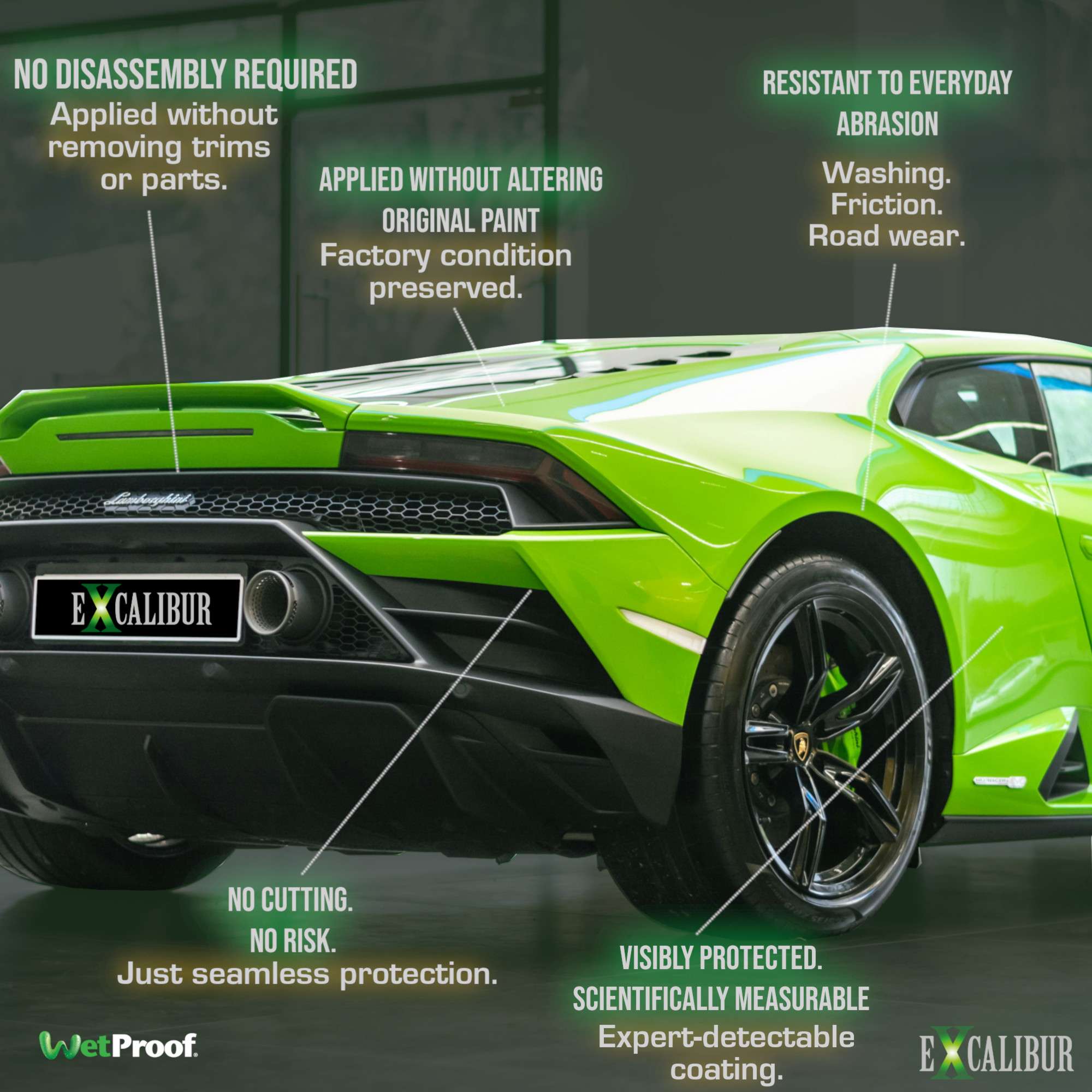
| Application | Liquid — no cutting, faster | Precision cutting & fitting, labor-intensive |
| Removal / lifting risk | Nothing to peel or lift | Can lift/peel; removal cost at end of life |
| Breathability / paint flexibility | Breathable — paint stays flexible | Sealed film layer over the paint |
| Corrosion & chemical resistance | TÜV corrosion + chemical certified | Protects covered panels only |
| Gloss & hydrophobic finish | Deep gloss, >110° water contact angle | Satin/gloss options; needs a top coat for beading |
| Cost & value | Whole-vehicle protection at a fraction of full PPF | Among the most expensive options, esp. full-body |
Note: This comparison is against PPF products commonly used in the industry. Excalibur's corrosion, hardness and UV performance are independently certified by TÜV, SGS and Eurolab (see Certifications). PPF offers a thicker physical barrier against direct stone impact on the front impact zones.
A recommendation by car and budget
There's no single right answer — the right answer depends on your car. Here's a realistic roadmap.
Brand-new ultra-luxury / collector car, budget no object
For track use, gravel roads or preserving resale on a six-figure car, add PPF on the front impact zones for maximum stone-chip absorption — then coat the whole car with Excalibur for gloss, chemical and UV protection where film is impractical.
Daily driver — wants gloss, easy care and value
For most drivers this is the sweet spot: invisible whole-car protection, deep gloss, self-healing and easy washing — without the cost and visible edges of a full film wrap.
Used or 3+ year-old vehicle
Full PPF often costs a meaningful share of the car’s value, which rarely makes sense on an older vehicle. Excalibur restores gloss and protects every surface at a far more sensible price.
Best possible outcome, balanced budget
PPF on the hood and bumper for direct impact, Excalibur everywhere else. You get physical stone protection where it matters most and complete, invisible coverage across the rest of the car.
Why choose one over the other at all?
PPF and Excalibur aren't rivals — they're complementary. Put PPF on high-impact areas like the hood and bumper, and Excalibur on the entire car, including glass, chrome and plastic. You get physical stone protection where it matters most, and invisible full coverage everywhere.
Documented, not just claimed
Excalibur's corrosion, 9H hardness and UV/yellowing performance were tested in independent labs by TÜV, SGS and Eurolab. Review the reports yourself.
Excalibur vs PPF: real questions
It depends on the car and the goal. PPF is a thick physical film that absorbs direct stone chips best, so it wins for track cars, gravel-road use and ultra-high-value vehicles on the front impact zones. For everyday drivers who want invisible whole-car protection, deep gloss, self-healing and easy care at a sensible price, Excalibur NanoFilm is usually the better fit — and the two can be combined (front PPF + full Excalibur) for the best of both.
Excalibur hardens on impact and absorbs minor chips and abrasion, but it is a thin coating, not a thick film. For heavy, direct high-speed stone impact (track, gravel roads), a 100–120 µm PPF film physically absorbs more. That is exactly why we recommend PPF on the front impact zones and Excalibur on the rest of the car for drivers who face that exposure.
Yes. A common setup is PPF on high-impact panels (hood, bumper, mirrors) with Excalibur NanoFilm over the entire vehicle — including the PPF itself. The coating adds gloss, hydrophobic easy-clean and UV protection on top of the film and covers every surface the film does not, such as glass, chrome and plastic trim.
Full-body PPF is one of the most expensive protection options because it is labor-intensive and material-heavy. Excalibur NanoFilm protects the entire vehicle for a fraction of a full PPF wrap, which is a big part of why it makes sense for daily drivers and used cars. Exact pricing is quoted per vehicle after inspection.
Excalibur builds a measurable, self-healing layer up to 85× thicker than a typical ceramic coating and adds impact, stone-chip and corrosion protection that ceramic does not. Ceramic mainly adds gloss and hydrophobicity with a near-zero measurable layer. Excalibur delivers the ceramic-style gloss and easy-clean plus real protection — while staying fully invisible.
Choose the right protection for your vehicle
Our certified installers inspect your car and recommend the setup that fits best — Excalibur, PPF or both.